
Adverse Events of Special Interest
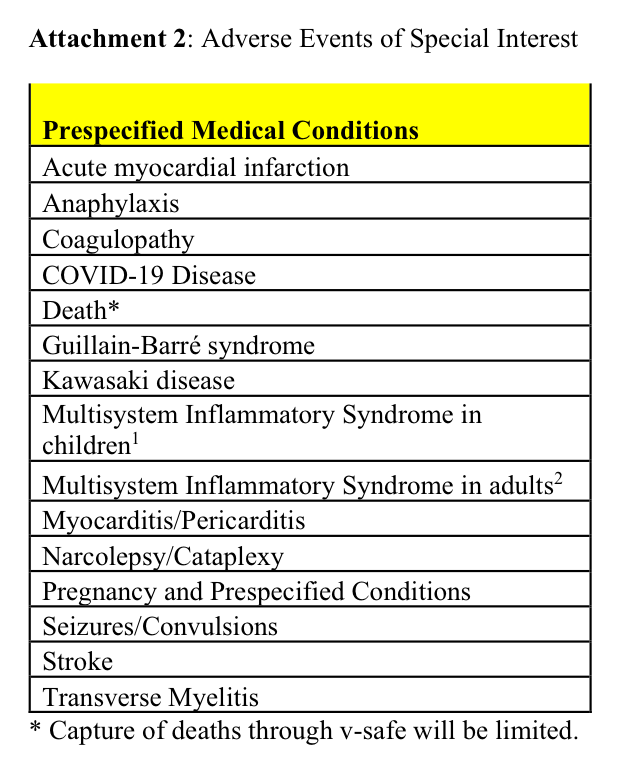
The CDC’s own v-safe protocol lists 15 Adverse Events of Special Interest (AESIs), the “prespecified medical conditions” it set out to watch for: heart attack, stroke, myocarditis, blood clots, seizures and more. The list is in Attachment 2 of every version of the protocol, from the first in November 2020 to the last in October 2022.
None of them was ever a check box in the v-safe surveys. The surveys asked about everyday reactions such as headache, fatigue and chills. The protocol’s plan was to count AESIs only through VAERS reports taken by the v-safe call center, so a condition reached the count only if the person had a call center case, was reached, and a report was filed.
This page does the count the CDC didn’t: across all 10,147,006 v-safe registrants, from what people wrote in their own words and the MedDRA codes the CDC gave that text, and then compares what v-safe recorded with how often each condition happens anyway, in the US population before the vaccines.
| AESI | People in v-safe | Per million | Only in their own words | Had a call case | VAERS match (names it) | v-safe VAERS reports |
|---|---|---|---|---|---|---|
| Acute myocardial infarction | 4,097 | 403.8 | 212 | 3,465 | 122 (62) | 137 |
| Anaphylaxis | 1,479 | 145.8 | 76 | 1,214 | 80 (18) | 50 |
| Coagulopathy | 12,072 | 1,189.7 | 1,540 | 9,997 | 601 (353) | 716 |
| COVID-19 Disease | 1,046,071 | 103,091.6 | 11,504 | 309,252 | 12,531 (8,091) | 12,388 |
| Death | 1,762 | 173.6 | 69 | 1,171 | 14 (8) | 18 |
| Guillain-Barré syndrome | 269 | 26.5 | 14 | 234 | 9 (4) | 17 |
| Kawasaki disease | 6 | 0.6 | 0 | 4 | 2 (1) | 1 |
| Multisystem Inflammatory Syndrome in children | 7 | 0.7 | 3 | 6 | 0 (0) | 0 |
| Multisystem Inflammatory Syndrome in adults | 5 | 0.5 | 3 | 3 | 0 (0) | 1 |
| Myocarditis/Pericarditis | 2,023 | 199.4 | 133 | 1,723 | 108 (56) | 138 |
| Narcolepsy/Cataplexy | 31 | 3.1 | 0 | 23 | 2 (1) | 7 |
| Pregnancy loss | 4,662 | 459.4 | 164 | 3,663 | 148 (96) | 151 |
| Seizures/Convulsions | 3,629 | 357.6 | 382 | 2,465 | 129 (71) | 146 |
| Stroke | 5,083 | 500.9 | 485 | 4,259 | 188 (109) | 226 |
| Transverse Myelitis | 88 | 8.7 | 2 | 75 | 4 (1) | 6 |
People are counted once per AESI. One person can have several AESIs. Hover a column heading for what it counts. “v-safe VAERS reports” are the 40,209 VAERS reports tagged as coming from v-safe.
Compared with how often it happens anyway
A count alone doesn’t say whether a condition was more common after the shot. Heart attacks and strokes happen every day. This compares the people whose first v-safe report of an AESI, found in their own words or in a MedDRA code, came within 7 or 42 days of a dose with the number of new cases expected in the same people over the same time, from 2019 US rates, before the vaccines.
| AESI | Within 7 days of a dose | Within 42 days of a dose | ||||
|---|---|---|---|---|---|---|
| Reported | Expected | Ratio | Reported | Expected | Ratio | |
| Acute myocardial infarction | 192 | 1,460 | 0.13×0.11–0.15 | 941 | 5,549 | 0.17×0.16–0.18 |
| Anaphylaxis | 729 | 48 | 15.07×13.99–16.20 | 1,032 | 172 | 5.99×5.63–6.36 |
| Coagulopathydeep vein thrombosis, pulmonary embolism, immune thrombocytopenia, disseminated intravascular coagulation | 1,262 | 3,137 | 0.40×0.38–0.43 | 4,548 | 11,763 | 0.39×0.38–0.40 |
| Guillain-Barré syndrome | 19 | 10 | 1.84×1.11–2.88 | 82 | 38 | 2.17×1.73–2.70 |
| Myocarditis/Pericarditis | 201 | 165 | 1.22×1.06–1.40 | 575 | 608 | 0.95×0.87–1.03 |
| Narcolepsy/Cataplexy | 4 | 156 | 0.03×0.01–0.07 | 7 | 557 | 0.01×0.01–0.03 |
| Strokenon-hemorrhagic stroke, hemorrhagic stroke | 331 | 1,148 | 0.29×0.26–0.32 | 1,408 | 4,366 | 0.32×0.31–0.34 |
| Transverse Myelitis | 5 | 7 | 0.69×0.22–1.60 | 25 | 27 | 0.94×0.61–1.38 |
Reported counts both: people who described it in their own words, and people whose call center case got a MedDRA code for it. Ratio = reported ÷ expected, with its 95% interval underneath. Highlighted: more reported than expected even at the bottom of the interval.
These are the 8 AESIs with a published US background rate: the 2019 rates by age and sex in Moll K, Lufkin B, Fingar KR, et al., “Background rates of adverse events of special interest for COVID-19 vaccine safety monitoring in the United States, 2019–2020”, Vaccine 2023;41(2):333–353, from the FDA’s BEST Initiative.
What it shows
- Anaphylaxis was reported about 15 times as often as expected in the first week after a dose, and 6 times over 42 days.
- Guillain-Barré syndrome was reported about twice as often as expected within 42 days.
- Myocarditis/pericarditis and transverse myelitis came out close to expected across all ages. Myocarditis after the mRNA vaccines is known to cluster in young men, which an all-ages ratio doesn’t show.
- The others came out below expected. That doesn’t mean they were rarer after the shot: v-safe only knows what people wrote down, and most people who have a heart attack or a stroke don’t report it to a phone survey. A ratio below 1 says little. A ratio above 1, in spite of that, is a signal.
- Insurance claims count every new diagnosis code, including some that are later ruled out, so claims rates run high for some conditions (narcolepsy especially). That also pushes the ratios down.
How it was worked out
- Time watched. For each dose, from the vaccination to the person’s last check-in within the window, stopping at their next dose: 1,246,706 person-years within 42 days, 347,109 within 7. Ages 16 and up (the background rates start at 18).
- Expected. Each person-year × the 2019 rate for that age band and sex, from Moll et al., Vaccine 2023 (FDA’s BEST Initiative): the median of five commercial insurance databases for ages 18–64, Medicare for 65 and up. These are new diagnoses in insurance claims.
- Reported. People whose first report of the AESI, in their own words or a MedDRA code, came in the window. A code doesn’t count when the person’s own words about it were all read or ruled “no” (a past history gets the same code as a new case).
- Blood clots are compared with deep vein thrombosis, pulmonary embolism, immune thrombocytopenia and DIC added together. These overlap, so the expected number is on the high side. Stroke is hemorrhagic plus non-hemorrhagic.
- Not compared: seizures (v-safe counts seizures in people with epilepsy), death (v-safe can’t capture most deaths), pregnancy loss, COVID-19, Kawasaki disease, MIS-C and MIS-A, for lack of a comparable US rate.
Acute myocardial infarction
4,097 people in v-safe, 137 v-safe VAERS reports. 212 were found only in their own words, never coded with one of its MedDRA terms. 3,465 had a call center case; 122 have a VAERS report we could match, and 62 of those reports name it.
People coded with these terms on the search page →
MedDRA terms counted (6)
Myocardial infarction, Acute myocardial infarction, Silent myocardial infarction, Acute coronary syndrome, Myocardial necrosis, ECG signs of myocardial infarction
Anaphylaxis
1,479 people in v-safe, 50 v-safe VAERS reports. 76 were found only in their own words, never coded with one of its MedDRA terms. 1,214 had a call center case; 80 have a VAERS report we could match, and 18 of those reports name it.
People coded with these terms on the search page →
MedDRA terms counted (4)
Anaphylactic reaction, Anaphylactic shock, Anaphylactoid reaction, Anaphylactoid shock
Coagulopathy
12,072 people in v-safe, 716 v-safe VAERS reports. 1,540 were found only in their own words, never coded with one of its MedDRA terms. 9,997 had a call center case; 601 have a VAERS report we could match, and 353 of those reports name it.
People coded with these terms on the search page →
MedDRA terms counted (85)
Thrombosis, Pulmonary embolism, Deep vein thrombosis, Pulmonary thrombosis, Superficial vein thrombosis, Immune thrombocytopenia, Thrombocytopenia, Coagulopathy, Thrombophlebitis, Cerebral thrombosis, Portal vein thrombosis, Embolism, Cardiac ventricular thrombosis, Peripheral artery thrombosis, Cerebral venous sinus thrombosis, Venous thrombosis limb, Ophthalmic vascular thrombosis, Venous thrombosis, Aortic thrombosis, Arterial thrombosis, Coronary artery thrombosis, Mesenteric vein thrombosis, Peripheral embolism, Splenic thrombosis, Subclavian vein thrombosis, Thrombotic thrombocytopenic purpura, Jugular vein thrombosis, Retinal vein thrombosis, Renal vein thrombosis, Embolic stroke, Pelvic venous thrombosis, Axillary vein thrombosis, Cerebral venous thrombosis, Carotid artery thrombosis, Retinal artery embolism, Retinal artery thrombosis, Peripheral vein thrombosis, Thrombotic stroke, Hepatic vascular thrombosis, Ovarian vein thrombosis, Disseminated intravascular coagulation, Renal artery thrombosis, Heparin-induced thrombocytopenia, Aortic embolus, Thrombocytopenic purpura, Renal vascular thrombosis, Transverse sinus thrombosis, Vena cava thrombosis, Thrombosis with thrombocytopenia syndrome, Hepatic vein thrombosis, Embolism venous, Cerebral artery embolism, Mesenteric artery thrombosis, Spinal artery thrombosis, Embolism arterial, Thrombosis mesenteric vessel, Ophthalmic artery thrombosis, Coronary artery embolism, Cerebral artery thrombosis, Brachiocephalic vein thrombosis, Ophthalmic vein thrombosis, Sigmoid sinus thrombosis, Splenic vein thrombosis, Brain stem thrombosis, Subclavian artery thrombosis, Subclavian vein embolism, Basilar artery thrombosis, Superior sagittal sinus thrombosis, Atrial thrombosis, Cerebellar artery thrombosis, Adrenal thrombosis, Pulmonary venous thrombosis, Pulmonary artery thrombosis, Precerebral artery thrombosis, Portal vein embolism, Femoral artery embolism, Splenic artery thrombosis, Haemorrhagic disorder, Abnormal clotting factor, Postpartum thrombosis, Postpartum venous thrombosis, Obstetrical pulmonary embolism, Spermatic vein thrombosis, Penile vein thrombosis, Retinal vascular thrombosis
COVID-19 Disease
1,046,071 people in v-safe (1,022,785 by the check-in answer “tested positive”), 12,388 v-safe VAERS reports. 11,504 were found only in their own words, never coded with one of its MedDRA terms. 309,252 had a call center case; 12,531 have a VAERS report we could match, and 8,091 of those reports name it.
People coded with these terms on the search page →
MedDRA terms counted (4)
COVID-19, SARS-CoV-2 test positive, COVID-19 pneumonia, Coronavirus infection
Death
1,762 people in v-safe, 18 v-safe VAERS reports. 69 were found only in their own words, never coded with one of its MedDRA terms. 1,171 had a call center case; 14 have a VAERS report we could match, and 8 of those reports name it.
People whose free text reports their death →
MedDRA terms counted (6)
Death, Sudden death, Sudden cardiac death, Cardiac death, Brain death, Completed suicide
Guillain-Barré syndrome
269 people in v-safe, 17 v-safe VAERS reports. 14 were found only in their own words, never coded with one of its MedDRA terms. 234 had a call center case; 9 have a VAERS report we could match, and 4 of those reports name it.
People coded with these terms on the search page →
MedDRA terms counted (2)
Guillain-Barre syndrome, Miller Fisher syndrome
Kawasaki disease
6 people in v-safe, 1 v-safe VAERS reports. 0 were found only in their own words, never coded with one of its MedDRA terms. 4 had a call center case; 2 have a VAERS report we could match, and 1 of those reports name it.
Too few to chart (6 people).
People coded with these terms on the search page →
MedDRA terms counted (1)
Kawasaki's disease
Multisystem Inflammatory Syndrome in children
7 people in v-safe, 0 v-safe VAERS reports. 3 were found only in their own words, never coded with one of its MedDRA terms. 6 had a call center case; 0 have a VAERS report we could match, and 0 of those reports name it.
Too few to chart (7 people).
People coded with these terms on the search page →
MedDRA terms counted (1)
Multisystem inflammatory syndrome in children
Multisystem Inflammatory Syndrome in adults
5 people in v-safe, 1 v-safe VAERS reports. 3 were found only in their own words, never coded with one of its MedDRA terms. 3 had a call center case; 0 have a VAERS report we could match, and 0 of those reports name it.
Too few to chart (5 people).
People coded with these terms on the search page →
MedDRA terms counted (1)
Multisystem inflammatory syndrome in adults
Myocarditis/Pericarditis
2,023 people in v-safe, 138 v-safe VAERS reports. 133 were found only in their own words, never coded with one of its MedDRA terms. 1,723 had a call center case; 108 have a VAERS report we could match, and 56 of those reports name it.
People coded with these terms on the search page →
MedDRA terms counted (14)
Myocarditis, Pericarditis, Myopericarditis, Carditis, Viral myocarditis, Viral pericarditis, Pericarditis constrictive, Pleuropericarditis, Immune-mediated pericarditis, Immune-mediated myocarditis, Autoimmune myocarditis, Eosinophilic myocarditis, Pericarditis infective, Hypersensitivity myocarditis
Narcolepsy/Cataplexy
31 people in v-safe, 7 v-safe VAERS reports. 0 were found only in their own words, never coded with one of its MedDRA terms. 23 had a call center case; 2 have a VAERS report we could match, and 1 of those reports name it.
Too few to chart (29 people).
People coded with these terms on the search page →
MedDRA terms counted (2)
Narcolepsy, Cataplexy
Pregnancy loss
4,662 people in v-safe, 151 v-safe VAERS reports. 164 were found only in their own words, never coded with one of its MedDRA terms. 3,663 had a call center case; 148 have a VAERS report we could match, and 96 of those reports name it.
The protocol lists “Pregnancy and Prespecified Conditions” as one AESI but never says what the prespecified conditions are. The nearest the CDC comes is its pregnancy registry amendment (March 2021), which planned to track pregnancy loss (miscarriage and stillbirth), pregnancy complications (pregnancy-induced high blood pressure, gestational diabetes, pre-eclampsia), birth outcomes (preterm delivery, small for gestational age, low birth weight, NICU stays) and major birth defects. This page counts only the first of those, pregnancy loss: miscarriage, stillbirth, ectopic, molar and chemical pregnancy, blighted ovum and missed abortion, post vaccination. A loss the person places before their first dose doesn’t count.
MedDRA terms counted (11)
Abortion spontaneous, Abortion spontaneous incomplete, Abortion missed, Abortion incomplete, Biochemical pregnancy, Ectopic pregnancy, Ruptured ectopic pregnancy, Foetal death, Foetal cardiac arrest, Stillbirth, Premature baby death
Seizures/Convulsions
3,629 people in v-safe, 146 v-safe VAERS reports. 382 were found only in their own words, never coded with one of its MedDRA terms. 2,465 had a call center case; 129 have a VAERS report we could match, and 71 of those reports name it.
People coded with these terms on the search page →
MedDRA terms counted (27)
Seizure, Epilepsy, Generalised tonic-clonic seizure, Partial seizures, Petit mal epilepsy, Febrile convulsion, Seizure cluster, Temporal lobe epilepsy, Status epilepticus, Simple partial seizures, Focal dyscognitive seizures, Tonic convulsion, Atonic seizures, Autonomic seizure, Myoclonic epilepsy, Clonic convulsion, Convulsions local, Occipital lobe epilepsy, Migraine-triggered seizure, Idiopathic generalised epilepsy, Frontal lobe epilepsy, New onset refractory status epilepticus, Juvenile myoclonic epilepsy, Juvenile absence epilepsy, Generalised onset non-motor seizure, Focal onset aware seizure, Focal onset impaired awareness seizure
Stroke
5,083 people in v-safe, 226 v-safe VAERS reports. 485 were found only in their own words, never coded with one of its MedDRA terms. 4,259 had a call center case; 188 have a VAERS report we could match, and 109 of those reports name it.
People coded with these terms on the search page →
MedDRA terms counted (38)
Cerebrovascular accident, Cerebral haemorrhage, Ischaemic stroke, Cerebral thrombosis, Haemorrhagic stroke, Subarachnoid haemorrhage, Cerebellar stroke, Cerebral venous sinus thrombosis, Brain stem stroke, Cerebral infarction, Thalamic stroke, Lacunar stroke, Embolic stroke, Occipital lobe stroke, Cerebral venous thrombosis, Basal ganglia stroke, Middle cerebral artery stroke, Thrombotic stroke, Spinal stroke, Parietal lobe stroke, Ischaemic cerebral infarction, Vertebrobasilar stroke, Stroke in evolution, Subcortical stroke, Haemorrhage intracranial, Cerebellar haemorrhage, Thalamus haemorrhage, Basal ganglia haemorrhage, Brain stem haemorrhage, Intraventricular haemorrhage, Cerebellar infarction, Lacunar infarction, Brain stem infarction, Thalamic infarction, Cerebral ischaemia, Frontal lobe stroke, Temporal lobe stroke, Cerebral artery occlusion
Transverse Myelitis
88 people in v-safe, 6 v-safe VAERS reports. 2 were found only in their own words, never coded with one of its MedDRA terms. 75 had a call center case; 4 have a VAERS report we could match, and 1 of those reports name it.
People coded with these terms on the search page →
MedDRA terms counted (3)
Myelitis transverse, Myelitis, Viral myelitis
How these were counted
- MedDRA codes. The CDC coded the v-safe free text into MedDRA terms. Each AESI has a narrow list of terms that clearly mean it, shown under each AESI above. Lab results, procedures, devices and look-alikes (heat stroke, osteomyelitis, menstrual clots) are left out.
- Free text. Each AESI also has word rules, run on all 7.5 million entries: they find the wording (“heart attack”, “blood clot in my leg”), skip what clearly isn’t it, and set aside entries that could go either way: someone else (“my dad had a stroke”), a fear or a maybe (“afraid of a heart attack”, “felt like a heart attack”), a denial (“no blood clots”), or a history from before the vaccines (any year up to 2020). Every one of those 9,511 set-aside entries was then read by hand. An entry counts only when it says the person had the condition, not just feared or suspected it, and not before the vaccine; 3,076 did. COVID-19's 27,959 set-aside entries were not read and are not counted, so its count is low, not high. A second reading checked 2,731 entries the rules had counted, where a history can slip past them (“I had GBS 30 yrs ago”): all of them for Guillain-Barré, transverse myelitis, narcolepsy, Kawasaki and MIS, and those within 42 days of a dose for anaphylaxis and myocarditis. 687 were taken out.
- Death and pregnancy come from the site’s own classifiers: the death reports in the free text, and pregnancy losses. For pregnancy loss, the 314 entries with wording of an earlier loss (“previous”, “years ago”, “2 miscarriages”, a year up to 2020) were all read, and a loss counts only post vaccination: not when the person places it before the vaccine, and not a standing diagnosis (“recurrent pregnancy loss”). The 3-, 6- and 12-month check-ins asked for new or worsening conditions since the last check-in, so a bare “2 miscarriages” there counts. 47 were taken out. COVID-19 also counts the check-in answer “tested positive”, which the surveys did ask.
- VAERS. “v-safe VAERS reports” are the reports tagged as coming from v-safe, counted by the same MedDRA terms. A VAERS match links one of those reports to a v-safe person’s call center case, by vaccination date, maker, sex, age, timing and symptoms; only matches scoring 8 or more of 11 are counted, as on each person’s page.
- When they first wrote about it. The date of the first survey whose free text or codes show the AESI, counted from the person’s most recent dose before it. That’s when they wrote about it, which can be days after it began. The time groups aren’t the same length: “0–1 days” is 2 days, “6–12 months” is about 180.
- Who reported it. People with the AESI in each age group and sex, per 100,000 v-safe users of that age group and sex. Age is the person’s age at their first dose. Each chart is scaled to its own highest bar, so compare shapes, not lengths, between AESIs. AESIs with fewer than 30 people aren’t charted.
- Background rates: see the comparison above. Counts and ratios show what was reported; they are not proof that the vaccine caused any one case.