
Analysis · 2026-10-29
The Preterm Babies in v-safe Came Earlier
Among v-safe users who wrote about a premature live birth, the share born before 28 weeks was about 1.8 times the pre-pandemic US share
When the CDC launched v-safe in December 2020, it was meant to be a safety net: a smartphone check-in system where newly vaccinated people could report how they felt. Alongside the check boxes there was a free-text box, and many people used it to describe what was happening to them in their own words.
Some of those people were pregnant.
At OpenVSafe (a project of OpenVAERS) we have made the full v-safe dataset searchable. One of the things we wanted to know was simple to ask and hard to answer: when pregnant v-safe users wrote about a premature birth, how early did those babies come? And how does that compare with what was normal before COVID-19 vaccines existed?
What we counted
v-safe never asked "how many weeks pregnant were you when you delivered?" So we read it out of the free text. We built a set of rules that pick up phrases like:
- "my baby was born at 33 weeks"
- "emergency c-section at 25 weeks and 2 days"
- "gave birth at 36+4"
- "baby came 6 weeks early" (counted against a 40-week term, so 34 weeks)
The rules only count text that is about a birth. "My period came 2 weeks early" doesn't count, and neither does "I was 25 weeks pregnant when I got my first dose." We kept only deliveries before 37 weeks, which is the medical definition of preterm.
That gave us 240 people who wrote down the week of a premature delivery. Ten of them also carry a CDC stillbirth code. Because the US figures we compare with count live births only, we left those ten out, so the comparison below is 230 live births against US live births.
These births came after vaccination. Free text has no date, so we checked: 233 of the 240 told v-safe they were pregnant at one of their check-ins, and none of the 207 with a dated birth code had it before their first dose.
What we compared it with
For a baseline we used the CDC's own final birth data for 2019, the last full year before the pandemic and before any COVID-19 vaccine: Births: Final Data for 2019 (National Vital Statistics Reports, vol. 70, no. 2). Table 21 breaks down every US live birth that year by week of pregnancy and by the mother's age.
Mothers' age matters, because older mothers have more preterm births. v-safe mothers skew older than US mothers overall, so we weighted the 2019 figures to the same age mix as the v-safe group. In practice it makes almost no difference: the share of preterm births before 32 weeks moves by less than half a percentage point.
Twins don't explain it either. Twins are born earlier, and the 2019 figures include them. But in the 2019 data, preterm singletons came slightly later than preterm births overall. Using singletons only would widen the gap a little, not close it.
One important point before the numbers
v-safe has no count of all the healthy, full-term births, because nobody writes "had a healthy baby at 39 weeks" in a box meant for problems. So we cannot compare how often babies were born preterm.
What we can compare is the shape of preterm birth: of the babies who were born early, what share came very early versus just a little early? Every percentage below is a share of preterm births only.
The results
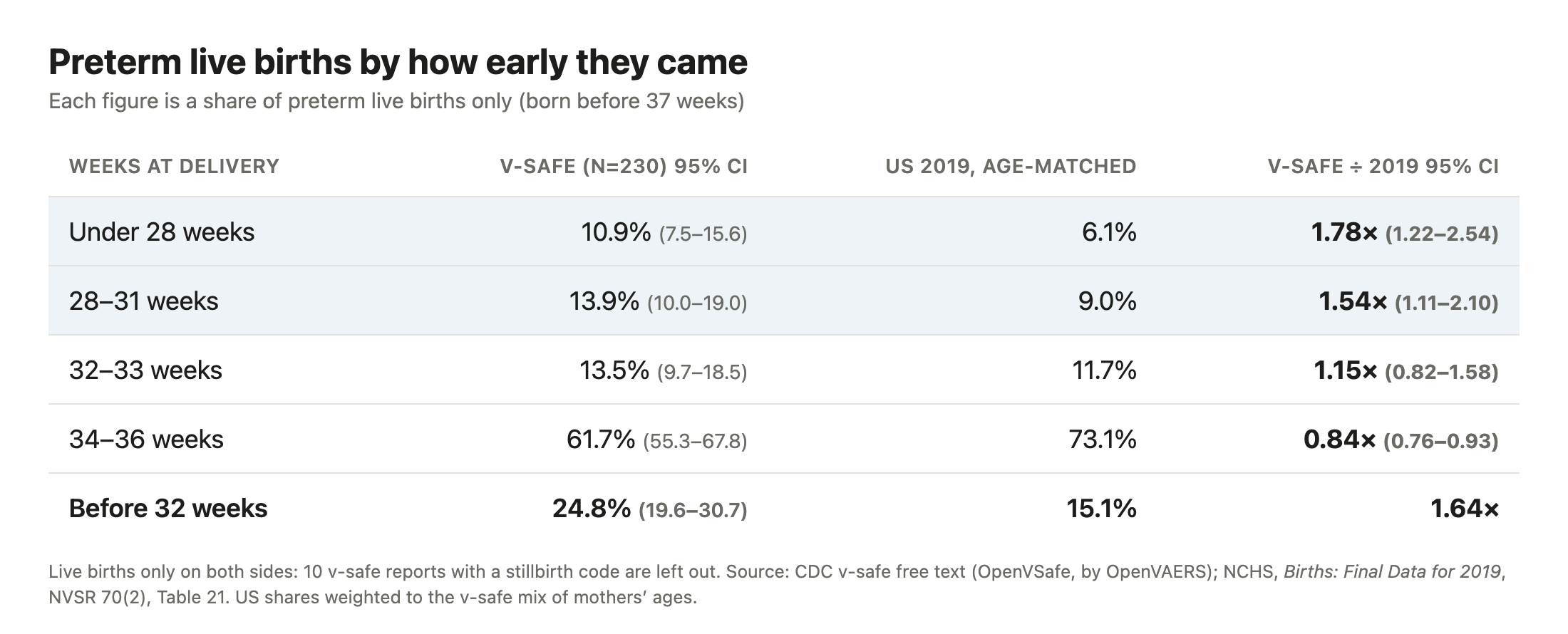
In 2019, most preterm babies in the US, about 73%, arrived in the last few weeks before term (34 to 36 weeks). Only about 6% came before 28 weeks, the range doctors call extremely preterm.
In v-safe the picture shifts toward the early end:
- Before 28 weeks: 10.9% of v-safe preterm live births, against 6.1% in 2019. That is 1.8 times the pre-pandemic share (95% interval 1.2 to 2.5 times).
- 28 to 31 weeks: 13.9% against 9.0%, about 1.5 times (1.1 to 2.1).
- 32 to 33 weeks: close to normal (13.5% against 11.7%).
- 34 to 36 weeks: fewer than expected (61.7% against 73.1%).
Put another way: about one in four v-safe preterm babies (24.8%) were born before 32 weeks, compared with about one in seven (15.1%) in 2019. That is about 1.6 times the 2019 share.
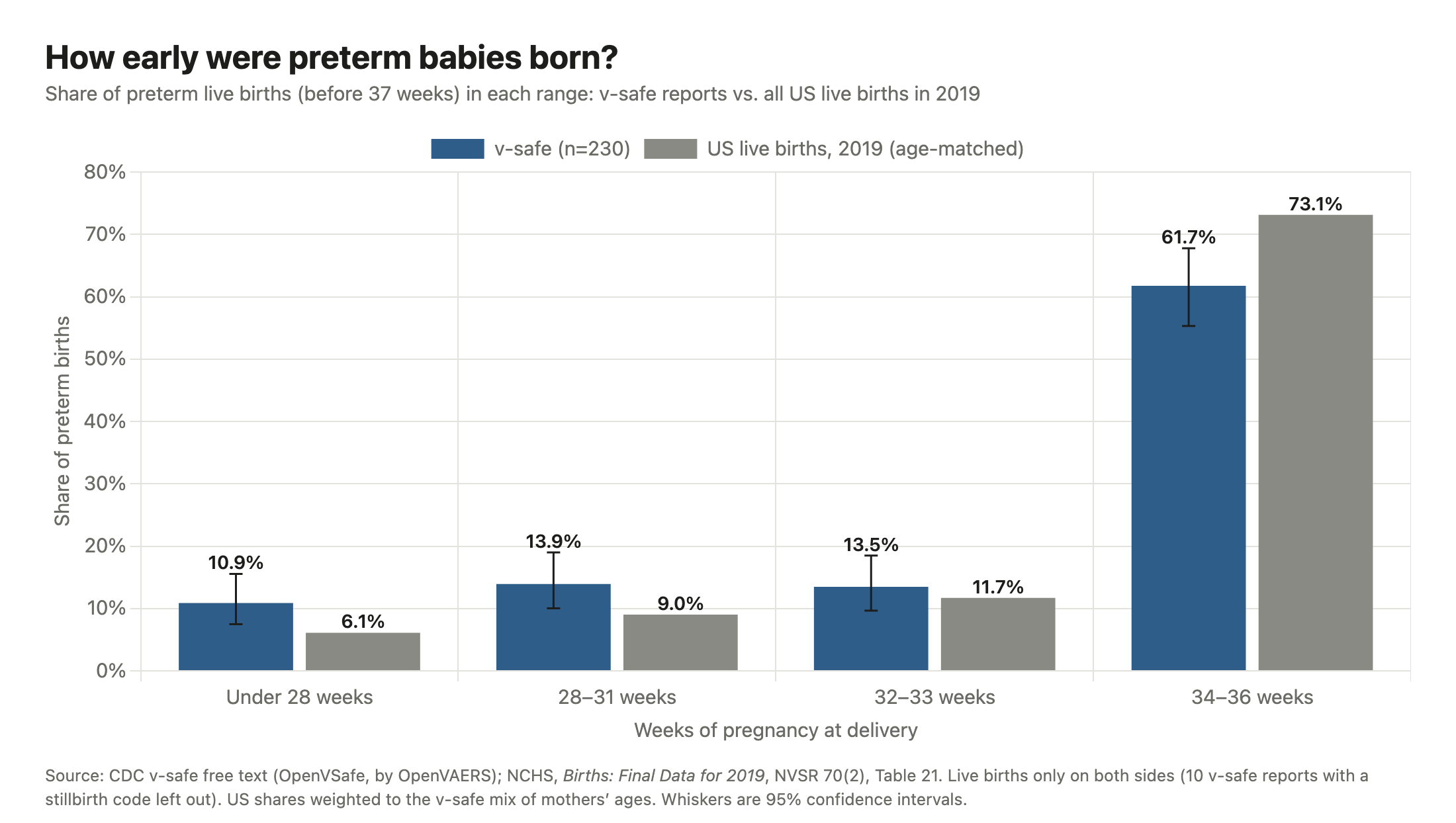
The black whiskers on the v-safe bars show the 95% confidence intervals: the range the true value probably falls in, given that we have 230 cases rather than millions. For the two earliest ranges, even the bottom of that range sits above the 2019 figure.
Is the difference just chance? Probably not: a chi-square test across the four ranges gives p = 0.0002. That test only asks whether these 230 births could be a random draw from all US preterm births, though, and nobody expects a self-reported sample to be one. The intervals above are the better guide to how big the difference is.
Did the survey itself make a difference?
Some pregnant v-safe users also answered v-safe's pregnancy follow-up questions. Among those respondents, 20.7% of preterm babies came before 32 weeks (95% interval 14 to 29%), against 28.6% for everyone else. Both are above the 2019 figure of 15.1%, but the survey group's shift is smaller and its interval reaches down close to the baseline. The two groups aren't clearly different from each other (p = 0.17), and they are too small to say more.
What could explain it?
There are two possible explanations, and the data alone cannot decide between them.
1. Which births got written about. People may have been more likely to write about a very early, very frightening delivery than about a baby who came at 36 weeks and went home after a few days. It wouldn't take much: if a mother who delivered at 26 weeks was about 1.8 times as likely to write about it as one who delivered at 35 weeks, that alone would produce the gap we see.
2. A real shift toward earlier delivery. The alternative is that the shift is real: that preterm births after vaccination tended to come earlier.
We tried to tell these apart. Among births a CDC coder recorded as an ordinary delivery, 26.7% were before 32 weeks, close to the 28.7% among the rest, so we saw no sign that the earliest births were the ones that got noticed. But that check is small, and it can't rule out a reporting difference of the size that would matter. We also checked whether early births were reported only because people stopped checking in later; they weren't, as check-in rates held at about 80% for the six months after the second dose.
So the honest summary is this: the preterm births written about in v-safe came earlier than pre-pandemic US births, age and twins don't explain it, and we can't rule out that very early births were simply more likely to be written about.
What the CDC's own studies found
The CDC has studied preterm birth after vaccination directly. Its first look at the v-safe pregnancy registry (Shimabukuro and colleagues, New England Journal of Medicine, 2021) reported a preterm birth rate of 9.4%, similar to pre-pandemic rates; most of those mothers were vaccinated in the third trimester. A larger CDC report on more than 46,000 births in the Vaccine Safety Datalink (Lipkind and colleagues, MMWR, 2022) found no increased risk of preterm birth after vaccination during pregnancy. Two things to know about that report: MMWR is the CDC's own weekly publication, reviewed inside the CDC rather than peer reviewed by outside experts, and the Vaccine Safety Datalink's records are not publicly available, so no one outside the CDC and its partner health systems can check the result against the data.
Those studies ask how often babies were born preterm. Ours asks how early the preterm babies came, which they didn't report. The two don't contradict each other, but readers should weigh our finding alongside theirs.
Limits worth knowing
- A self-selected group. These are v-safe users who chose to write down the week of a premature birth, not a defined group of pregnancies followed to delivery. They are about 5% of the pregnant v-safe users, and every finding here is about them.
- Small numbers. 230 births is enough to show a difference, but not enough to break down by vaccine brand or trimester at vaccination. Only 7 of the mothers became pregnant after vaccination: far too few to compare.
- Free text is messy. An independent hand-read of all 240 entries found 6 misread weeks (3 too early, 3 too late) and about 25 preterm births our rules missed. Correcting the misreads leaves the before-32 share at about 25%. Some known rule errors, such as "34 weeks (5 weeks early)" being read as 35, are still to be fixed.
- Rounded weeks. Many people wrote "6 weeks early" rather than a week, which we count as 34 weeks, so 34 weeks shows up more often than it should. It doesn't change the four ranges much, but individual weeks aren't precise.
- Other differences. Matching on age doesn't make the groups identical. v-safe mothers differ from US mothers in other ways too, including race and income, and the v-safe data doesn't let us match on those.
- Ages are approximate. v-safe records age in five-year bands (31–35, for example), so we matched each band to the nearest CDC age group (30–34).
Why this matters
The CDC built v-safe to watch for signals like this one. The data was collected from people who did what they were asked: they got vaccinated, they checked in, and when something went wrong, they wrote it down.
An extremely preterm baby is not a statistic. Babies born before 28 weeks face the highest risks of death and lifelong disability of any group of newborns. Among the people who wrote to the CDC's own safety system about a preterm birth, the share born that early was well above the pre-pandemic norm. The data we have can't say whether that reflects what happened or what people chose to write about. Answering that needs the full count of births and their dates, which the CDC holds and we don't.
You can explore the data yourself on the OpenVSafe pregnancy survey page and search the free-text entries.
Sources
- CDC v-safe free-text responses, searchable at OpenVSafe (by OpenVAERS).
- Martin JA, Hamilton BE, Osterman MJK, Driscoll AK. Births: Final Data for 2019. National Vital Statistics Reports, vol. 70, no. 2. National Center for Health Statistics, 2021. Table 21. https://www.cdc.gov/nchs/data/nvsr/nvsr70/nvsr70-02-508.pdf
- Martin JA, Hamilton BE, Osterman MJK. Births in the United States, 2019. NCHS Data Brief no. 387, 2020. https://www.cdc.gov/nchs/products/databriefs/db387.htm
- Shimabukuro TT, Kim SY, Myers TR, et al. Preliminary Findings of mRNA Covid-19 Vaccine Safety in Pregnant Persons. New England Journal of Medicine 2021;384:2273–2282. https://doi.org/10.1056/NEJMoa2104983
- Lipkind HS, Vazquez-Benitez G, DeSilva M, et al. Receipt of COVID-19 Vaccine During Pregnancy and Preterm or Small-for-Gestational-Age at Birth. MMWR 2022;71(1):26–30. https://www.cdc.gov/mmwr/volumes/71/wr/mm7101e1.htm
Method notes
Preterm deliveries were read from v-safe free text with pattern rules (weeks 20 to under 37; "N weeks early" counted as 40 − N). People with an active MedDRA "Stillbirth" code (10 of 240) were excluded so that both sides count live births. The 2019 US shares for each gestational range were taken by mother's age group from NVSR 70(2), Table 21, and weighted by the age mix of the 230 v-safe mothers. Confidence intervals are Wilson 95% intervals; intervals for the ratios divide the Wilson bounds by the 2019 share. The chi-square goodness-of-fit test has 3 degrees of freedom (chi-square 19.3).